
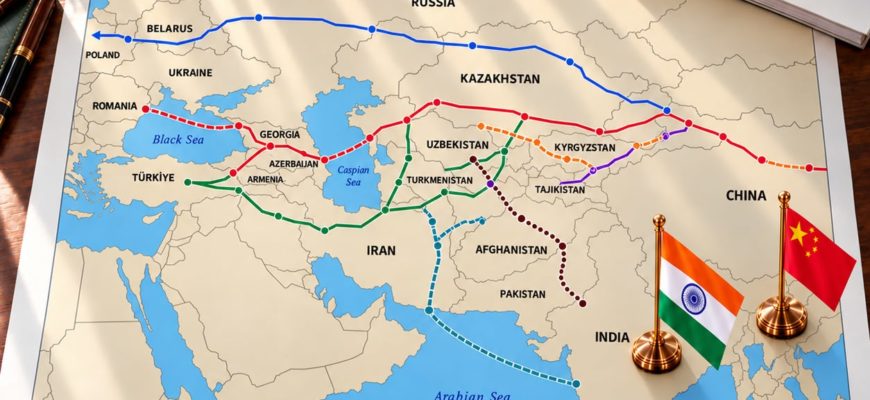
India is expanding its engagement with Central Asia, where other external partners already offer capital, technology and access to markets. Uzbekistan, Kazakhstan, Kyrgyzstan, Tajikistan and Turkmenistan have a choice of partners and seek to use these relationships to develop their industries and exports. Progress under India’s Connect Central Asia policy will depend on New Delhi’s ability to offer each of the five countries projects that reflect its priorities and economic potential.
India seeks uranium, critical minerals and new markets for its companies. Central Asian countries welcome buyers for their raw materials, while also seeking to expand domestic processing and manufacturing. This is a central issue in their negotiations. Indian partners need access to resources, while Central Asian governments have an interest in retaining a greater share of production and the resulting income within their economies.
Uzbekistan’s recent progress in relations with India illustrates the scale of New Delhi’s ambitions. During Prime Minister Narendra Modi’s visit to Tashkent on August 30, the two countries elevated their relationship to a Comprehensive Strategic Partnership and set a target of $5 billion in bilateral trade by 2030. Trade stood at $1.3 billion in 2025. The agenda covers uranium, critical mineral exploration and processing, pharmaceuticals and digital technologies. Around 400 enterprises with Indian investment already operate in Uzbekistan. This provides a business foundation for growth, although reaching the trade target will require additional contracts, investment and deliveries. For Tashkent, a valuable outcome would be new production capacity serving both domestic and export markets.
Kazakhstan approaches cooperation with its own strengths and priorities. The two countries have previously concluded agreements on uranium supplies. According to Kazakhstan’s Ministry of Foreign Affairs and Kazakh Invest, bilateral trade amounted to $923.3 million in 2025. At a bilateral business forum in Chennai on September 8, participants discussed oil and gas, pharmaceuticals, critical minerals, digital technologies and renewable energy. Further cooperation in the resource sector will depend on whether Indian partners support their purchases with long-term contracts and investment in processing. For Kazakhstan, this could create opportunities to retain more value domestically and reach additional export markets.
Kyrgyzstan and Tajikistan offer a different basis for cooperation. Kyrgyzstan already has telemedicine links between hospitals and projects supporting medical and technical infrastructure. In Tajikistan, Indian companies have worked in electricity transmission and distribution. The practical value of these projects lies in reliable services and the development of local expertise. They also offer opportunities for cooperation that are less dependent on moving large volumes of freight.
For Turkmenistan, diversifying energy exports remains an important priority. The TAPI pipeline was conceived to deliver Turkmen gas to India through Afghanistan and Pakistan. Turkmenistan reports construction work towards Herat, but the full route to India remains incomplete and gas deliveries have not begun. Ashgabat’s interest in additional buyers aligns with India’s demand for energy. Implementation nevertheless requires coordinated arrangements for construction, financing, security and transit along the entire route.
Transport constraints affect other areas of cooperation as well. India has no direct overland access to Central Asia. New Delhi has invested in equipment at Iran’s Chabahar port to support shipments by sea to Iran and onward by land to Central Asian markets. The port’s commercial value depends on the reliability of the full transport chain. Instability in Iran and sanctions restrictions complicate shipping, payments and insurance. For mining and processing companies, these conditions affect equipment costs, working capital and export competitiveness. Access to a deposit alone therefore does not make a project commercially viable.
China’s advantage in this environment rests on the combination of a large market and established infrastructure. According to Beijing, trade in goods between China and the five Central Asian countries reached $106.3 billion in 2025. Rail links through Kazakhstan support freight movements, while the existing pipeline carries Central Asian gas to China through Uzbekistan and Kazakhstan. The railway under construction between China, Kyrgyzstan and Uzbekistan could expand the region’s transport options once completed. At the second Central Asia–China summit in Astana on June 17, 2025, the participants reaffirmed their intention to expand industrial and investment cooperation.
These connections allow Chinese companies to combine raw material purchases with equipment supplies, construction and access to end markets. India will be developing projects in an economic environment where such arrangements already exist. Central Asian countries also pursue investment and trade opportunities with the EU, the United States, Russia, Türkiye, Japan and the Gulf states. The attractiveness of Indian proposals will therefore depend on the terms they offer compared with those available from other partners.
The Middle Corridor is particularly relevant. It connects China with European markets through Kazakhstan, the Caspian Sea, Azerbaijan and Georgia, continuing through Türkiye or across the Black Sea. Its development broadens transport options for Central Asian countries and supports exports of their own products. For India, potential links between routes through Iran and this network could provide additional shipping options and make joint production in the region more attractive. Commercial viability will depend on coordinated tariffs, efficient border procedures, cargo transfers and reliable delivery throughout the journey.
Over the next three to five years, cooperation with India is likely to expand gradually, with progress varying across countries and sectors. Digital services and specialist training may produce results sooner than major mining and infrastructure projects. Growth in pharmaceuticals will also depend on product registration, quality standards and access to procurement. In the mineral sector, financing, sustained demand and transport costs will determine the pace of development. If uncertainty over transport and payments involving Iran persists, large projects dependent on substantial freight movements progress is likely to be limited to selected projects. TAPI remains a long term opportunity until the conditions for completing the route and beginning deliveries are secured.
China is likely to retain a substantially larger economic presence over this period. India can strengthen its position in sectors where its demand, technology and investment meet local priorities. Progress could accelerate where long term purchasing commitments are supported by financing for production and predictable logistics.
New Delhi should focus on commercially sustainable projects that connect Indian demand with the industrial priorities of its Central Asian partners. For the countries of the region, success will be measured by new production capacity, local expertise and export opportunities. Delivering these mutual benefits would give Connect Central Asia a durable economic foundation and help strengthen India’s wider relations with the region.
Author

Azat Serikbossyn – Deputy Executive Director, expert on the Asia-Pacific and Indo-Pacific regions (geo-economics, logistics, digital systems, and regional integration). Fluent in Kazakh, Russian, English, Hindi, and Urdu.


